Certificates & records
What a completed course produces
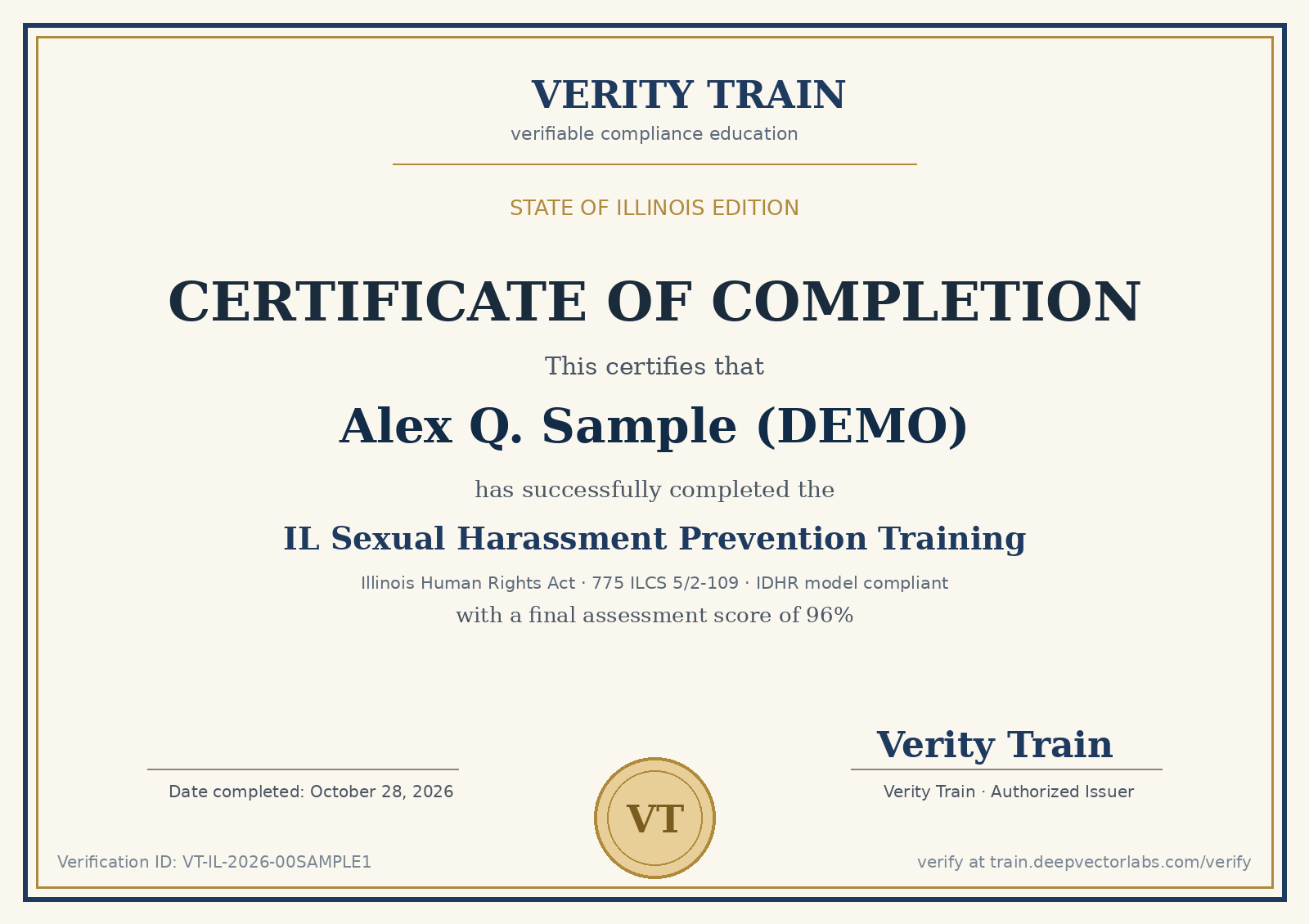
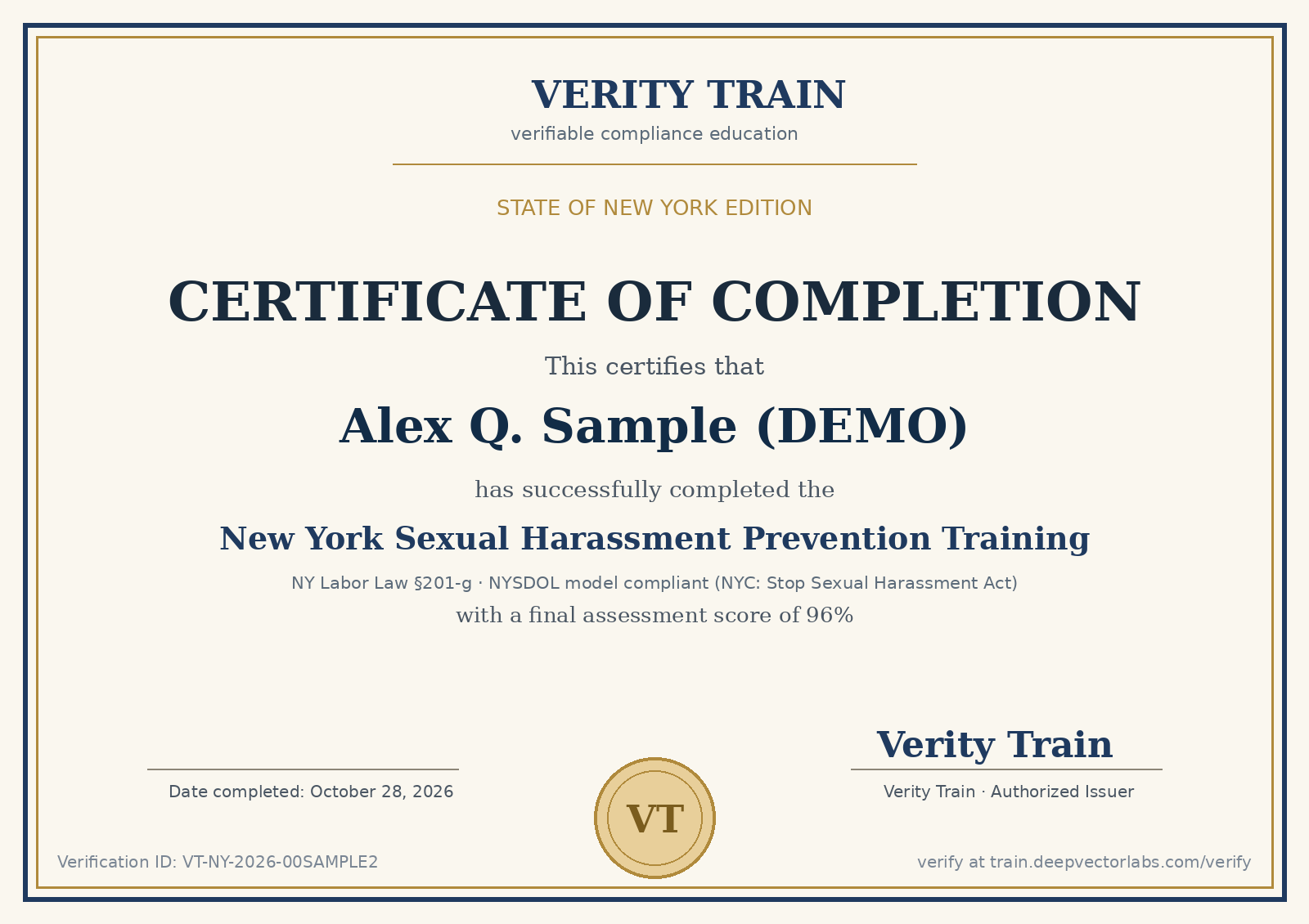
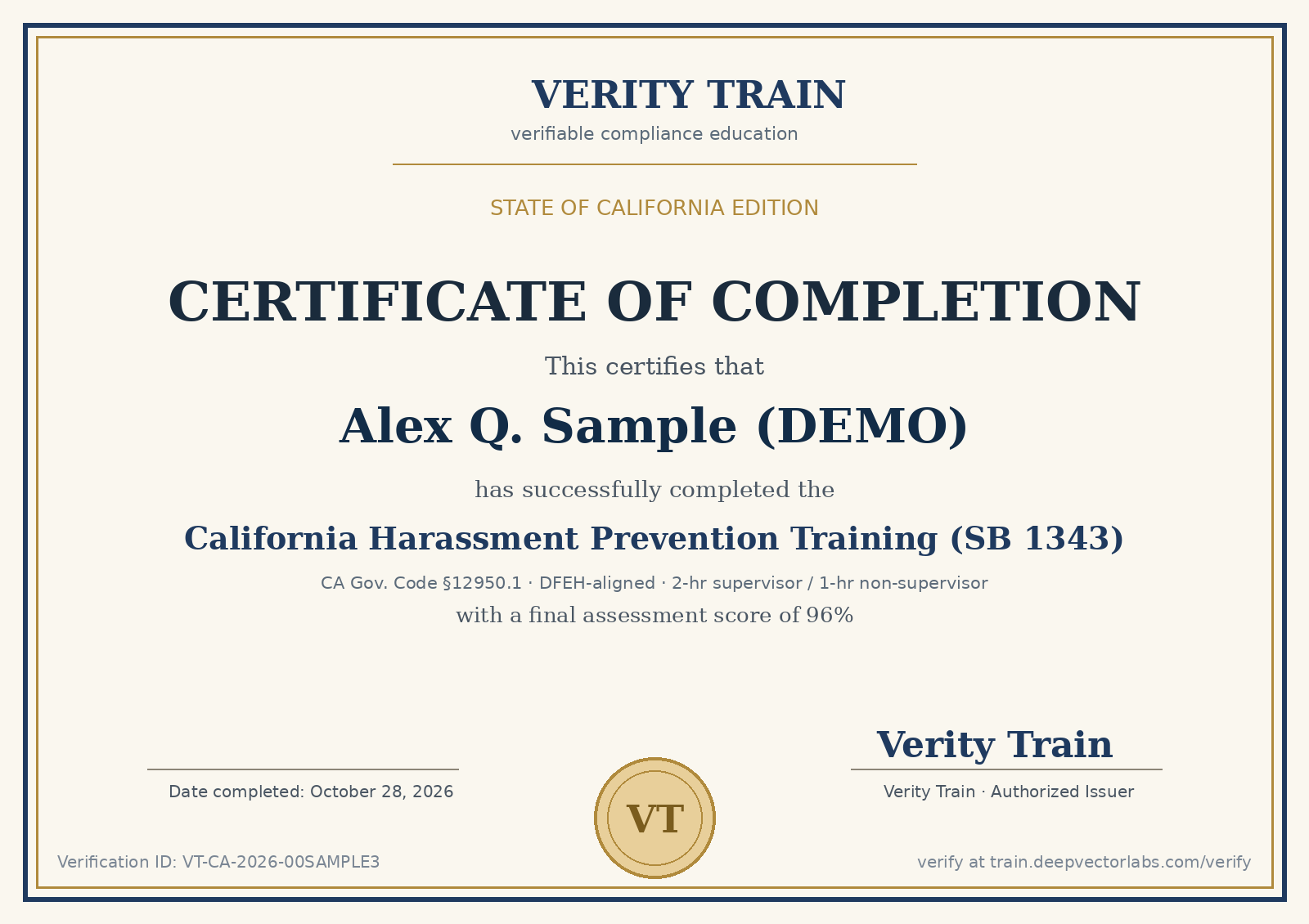
When an employee passes the final lesson, the assignment flips to completed and two things are created:
- A certificate (PDF) carrying the employee's name as entered on the roster, the company name, the course title and state, the completion date, the governing statute citation (e.g. "Satisfies the annual training requirement of N.Y. Labor Law §201-g"), and a unique Certificate ID.
- An audit-trail row for the issue event, joining the rows already written for the assignment, each quiz attempt and pass, and the completion — a full chronological chain from invitation to certificate.
The statute citation on the face of the document is deliberate. A regulator reading your file shouldn't have to guess which duty the document answers — the certificate says so.
Verification IDs
Every Certificate ID is unique and resolvable. Anyone holding the PDF — an investigator, an auditor, opposing counsel, your own insurer — can use the verification line to check that the certificate corresponds to a real issued record, not a retyped document. Treat the IDs the way you treat check numbers: they exist so that "trust me" is never part of your compliance posture.
Downloading PDFs
Certificates are downloadable from the completed assignment and from the employee's record, one at a time or in bulk for a roster sweep. Employees can also download their own. There is no per-download fee and no reason to wait: grab the PDFs when a cycle completes and file them with the rest of your HR records, even though the platform keeps its own copy.
How long you must keep the proof — per state
No state collects these records in advance; every state expects them to exist when asked. The windows:
| Jurisdiction | How long to keep records | Produce to | Statute / source |
|---|---|---|---|
| New York State | No fixed statutory period; keep at least 3 years — the DHR accepts complaints up to 3 years after an incident | Division of Human Rights, on complaint or investigation | N.Y. Labor Law §201-g + DHR filing window |
| New York City | At least 3 years, including a signed acknowledgment (electronic is fine) | NYC Commission on Human Rights, on request | NYC Admin. Code §8-107(30) |
| Illinois | No fixed period in the statute; records must exist to prove compliance. Keep 5 years where Chicago employees are involved | Illinois Department of Human Rights, on request | 775 ILCS 5/2-109 |
| Chicago | At least 5 years, longer while a complaint is pending | Chicago Commission on Human Relations, on request | Muni. Code §2-160 |
| California | Minimum 2 years: names, dates, certificates or sign-in sheets, training type, materials, provider | Kept on your own premises — CRD is explicit these are not sent to the state | Cal. Gov. Code §12950.1; CRD employer FAQ |
| Connecticut | No fixed period; keep for the employment relationship | CHRO, on inquiry | Conn. Gen. Stat. §46a-54(15)(B) |
| Maine | At least 3 years, including attendance | Maine Department of Labor (Bureau of Labor Standards), on inspection | 26 M.R.S. §807 |
The conservative rule that covers every row of that table at once: keep completion proof for the whole employment relationship plus the longest window above it. Storage is cheap; a gap in a harassment investigation is not.
The audit log — and our export promise
Every lifecycle event in Verity Train writes an audit row: assigned, reminded, quiz failed, quiz passed at score, completed, certificate issued. The log is per-employee, timestamped, and chronological — the answer to "prove this person was trained in 2025" that a signed sheet of paper can never quite give.
Our standing promise:
- The full audit trail for your company is exportable to CSV, on demand, whenever you want it — not by request, not by support ticket.
- Exports are included in every plan at every price. Compliance records you can't take with you aren't records; they're a hostage negotiation.
- Certificates for completed assignments remain downloadable for as long as your account is active, matching or exceeding every retention window in the table above.