Add your company and roster
Sign up, name your company, and tell us which states your employees work in. Add employees one at a time or paste a list. Each person gets a role — employee or supervisor — and an email invitation.
New York, Illinois, and California make harassment-prevention training a legal duty with no small-business exemption. Verity Train delivers the state-required course, quizzes, certificates, and audit trail — for $8 per employee per year.
Statute citation printed on every certificate · New York §201-g · Illinois 775 ILCS 5/2-109 · California Gov. Code §12950.1
Three steps. No software to install, no administrator certification, no consultants.
Sign up, name your company, and tell us which states your employees work in. Add employees one at a time or paste a list. Each person gets a role — employee or supervisor — and an email invitation.
Verity Train picks the correct course and due date for each person from their state and role: annual clocks for New York and Illinois, a 24-month clock for California, 1-hour employee and 2-hour supervisor tracks where the law sets different durations.
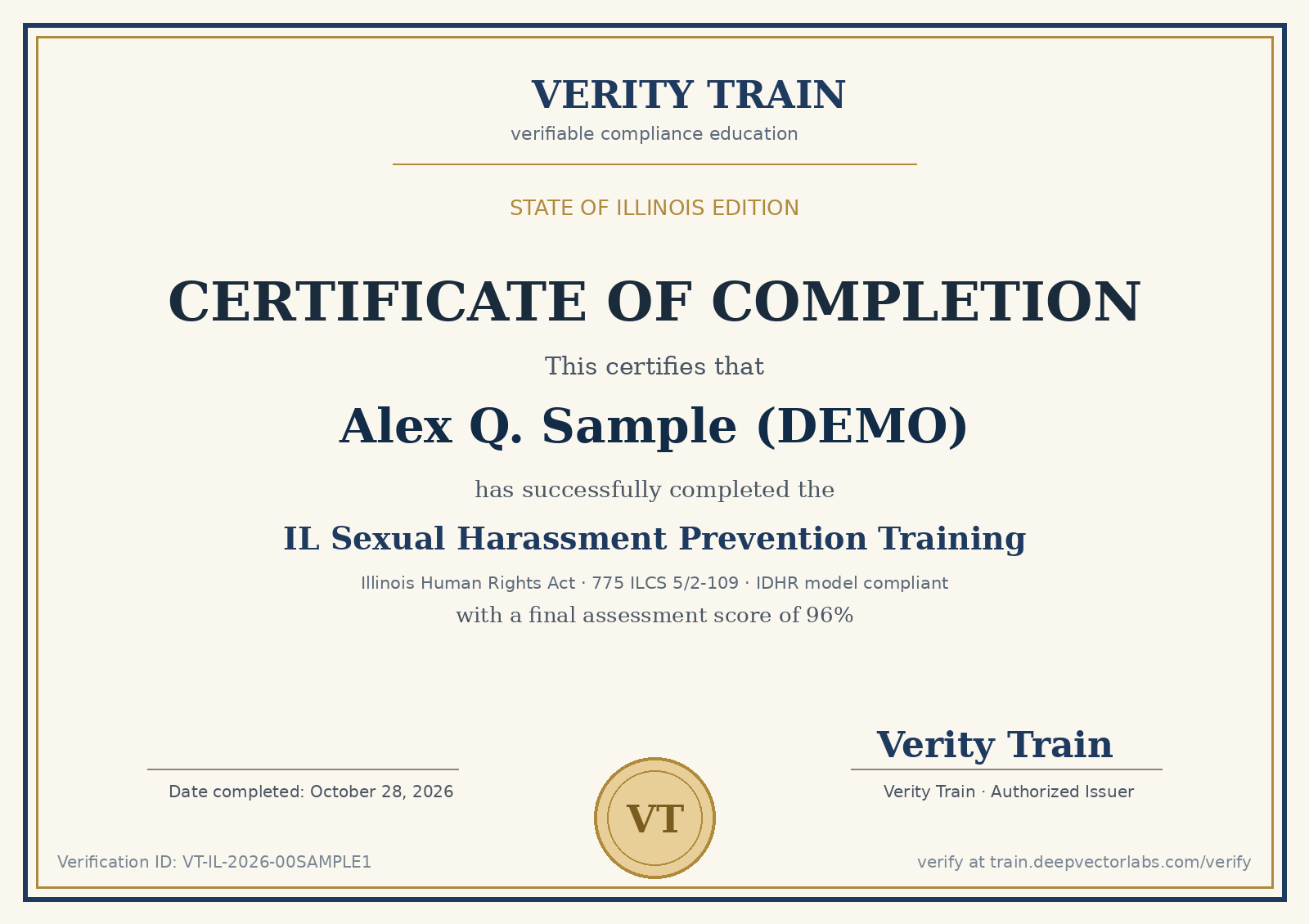
Quiz-gated lessons enforce the interactivity the statutes demand. Completed training issues a certificate with the statute citation and a unique verification ID — and every event lands in your audit log, exportable whenever an agency or attorney asks.
Every course is built from the state's own statutory checklist — not a generic template with a state name slapped on it. If the law adds a topic, the course gets a lesson.
Annual interactive training for every employer, no matter the headcount. Covers the NY DOL/DHR minimum standards: statutory definitions, examples, remedies, complaint forums, and supervisor responsibilities.
Clock: 12 months · Supervisor content embedded · Written policy + notice modeled
Annual training for all Illinois employees, meeting or exceeding the Department of Human Rights model program. Restaurants and bars add the industry-specific supplement required by 775 ILCS 5/2-110.
Clock: 12 months · Restaurant/bar supplement included · IDHR-inspection-ready records
Separate tracks at the statutory durations: 1 hour for nonsupervisory staff, 2 hours for supervisors, on a 24-month cycle, with abusive-conduct and gender-identity content as §12950.1 requires.
Clock: 24 months · 1-hr / 2-hr tracks · New-hire within 6 months
2-hour interactive course for all employees at employers of three or more, within six months of hire, with the 10-year refresher tracked for you.
The NYC ordinance layer — bystander intervention, 15-employee trigger, calendar-year cycle — and Delaware's 50+ employer, every-2-years mandate with its added supervisor session.
Chicago's 1-hr / 2-hr prevention courses plus the annual bystander hour and 5-year records; Maine's new-hire program, supervisor add-on, and the annual written notice it layers on.
None of these laws create a filing system. There is no state portal to upload certificates to, no registry to post completions to, no agency that collects your training records in advance. The statutes work one way: you train on schedule, you keep the proof, and you produce it only when a complaint, an inspection, or a lawsuit puts your compliance in question.
That makes the audit trail the entire compliance product. A signed acknowledgment you can't find is the same, in an interview with an investigator, as training that never happened.
Documentation of the training should not be sent to CRD but should be kept on the employer's premises.
Verity Train writes an audit row for every assignment, quiz result, pass, and certificate — timestamped, per employee, exportable to CSV. Certificates carry the statute citation and a unique verification ID, so the proof you hand over looks like what it is: a compliance record, not a participation trophy.
Tell us where your people work and how many you have. We'll show you the exact statutory duties — frequency, track durations, new-hire windows, and how long the records must be kept.
Summary of statutory duties, not legal advice. Statutes change; we re-verify every state pack against the primary source before it ships.
Every tier includes every state course, every feature, and unlimited annual re-runs. The per-employee rate drops automatically as your roster grows — no negotiation calls.
$8 / employee / year
$6 / employee / year
$5 / employee / year
Prices are per employee per year, all states included. A company of 40 pays $320 a year — less than one hour of employment-counsel time.
Enterprise training vendors are built for 10,000-seat rollouts and priced that way. The mandate is identical at fifty seats.
| What you get | Verity Train | Ethenaenterprise LMS | EasyLlamaper-course vendor | Traliantenterprise vendor |
|---|---|---|---|---|
| Published entry price | $8 / employee / year | ~$20 / learner / year | ~$20 per training course | Quote only — sales call required |
| Per-course fees when states stack | None — every live state included | Catalog subscription | Each state course priced separately | Quote only |
| Statute citation on the certificate | On every certificate | Generic completion certificate | Generic completion certificate | Generic completion certificate |
| Audit trail export for inspections | CSV export, every lifecycle event | Reporting add-ons vary by plan | Dashboard reporting | Reporting in contract |
| Minimum seat counts / sales process | None — sign up and train in an afternoon | Sales-led onboarding | Self-serve at retail per-course prices | Sales-led, contract minimums |
| Built for | SMBs with 5–500 employees | Mid-market / enterprise | Broad SMB market | Enterprise |
| Competitor figures are publicly advertised entry points at the time of writing; all three vendors reserve volume discounts. "Generic completion certificate" refers to certificates without the governing statute printed on the document itself. | ||||
No — none of the states we cover asks you to file anything. New York, Illinois, and California all follow the same model: train on schedule, keep the proof, produce it on request. California's Civil Rights Department says explicitly that training documentation should not be sent to the state. The records are your compliance, which is why Verity Train's audit log — every assignment, pass, and certificate, exportable to CSV — is built to be the artifact you hand over.
Feedback, not just playback. New York's guidance is explicit that watching a video alone does not count — the training has to elicit responses, such as end-of-section questions the employee must answer. Verity Train gates every lesson with a quiz and requires 80% to advance, so each record shows participation rather than a played video.
Where the law says so. California requires a 2-hour supervisory track against the 1-hour employee track, and Illinois and New York mandate supervisor-specific content. When you mark someone as a supervisor, Verity Train assigns the supervisory track that their state requires — you don't choose courses by hand.
Our courses are built directly from each state's published mandated-content checklist, mapped 1:1 and held on file, then delivered through a lightweight platform instead of an enterprise LMS. The mandate is the content spec; the states already wrote it. We pass the savings through because our real product is the clock and the audit trail, not a video catalog.
New York, Illinois, and California are live today. Connecticut, Delaware, Maine, the NYC ordinance, and the Chicago ordinance are in production and ship next. One subscription covers every state we offer — no per-state add-ons.
The assignment stays open and overdue, reminders continue, and the gap is visible on your dashboard. The due-date clock never stops, so the risk is never hidden — which is what you want, because "we didn't know" is the answer that fails inspections.
The one for the state where they work — assignments are made per employee, not per company. A 30-person company spread across New York, Chicago, and Los Angeles gets three different tracks assigned automatically, and the city-layer rules (NYC, Chicago) are applied on top of the state mandate.
Annual duty in New York and Illinois. Every two years in California. Citations on every certificate, an audit log behind every claim, and a price that doesn't need a meeting.
Start training — $8 / employee / year